| Henry Powers' - The Experience | ||||||||||||||||||||||
The
24th Evacuation Hospital
The
Dustoff aircraft advises the number and type of casualties he has
on board and his ETA. A&D advises the pilot he has a good
copy and will be waiting (and gives any special information such
as wind conditions and visibility.)
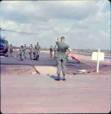
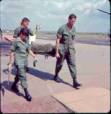
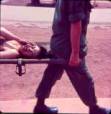
Litter
exchanges are made….. one fresh litter for each casualty on
a litter… (no, it is not a common occurrence to see a nurse
on the helipads). Now, those guys look like they are just taking
it easy moving the casualties; well, they are not, too bad you cannot
see the rapid pace these guys used. Then of course, there was
always the "hot one" that required even faster movement…
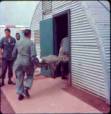
The
casualties are taken through A&D into the Emergency Room Where
they are stripped down, identifying wristbands are placed on the
patient, their clothing, valuables, and any armaments they have with
them are collected and recorded on a deposit slip. Any arms
or other items are placed in the Weapons Conex next to the A&D
Office.
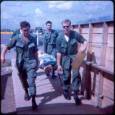
I know you are just dying to know why the casualties are carried through the A&D office into the Emergency Room….there are several reasons, the most obvious being, it is there that "traffic control" occurs; keeping unnecessary personnel out of the ER so the staff can take care of the patients. Also, the A&D area was used for litters when we had more casualties than litter stands. Once the ER personnel have finished with the patient, the Litter Bearers then move them to X-ray, Lab, or Pre-Op to await the definitive treatment required by their wounds. The
Second Hardest part of their job was having to haul these guys into
the ER..
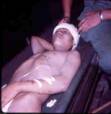
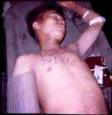
When we got
VC casualties in, usually they had already been stripped down and
had VC and 24th Evac. marked on their chest with a felt
tipped marker. One thing we learned early on, just because
the guy looked like he was either sleeping or maybe unconscious,
don't take a chance. The guy at the back of the litter would
always keep an eye on him, just in case it became necessary to suddenly "drop
the litter", letting the VC get a sudden headache. I can
truthfully say that it never became necessary to develop sweaty palms
and "drop" the litter.
Boy,
that could have been embarrassing had the A&D guys not been on
their toes…
It's
feeding time for Baby-san!!
Charlie
is a Scout Dog, just another G.I…..
Yes,
the working dogs of the army were considered soldiers and were authorized
treatment at any medical facility that was available, we got Charlie's
serial No. from his ear!!! Paperwork showed the next of kin as his
handler…sorry, I do not remember the soldier's name!
Safely on the ground The
A&D guys got the casualties off the bird, out of the rain and
into the ER!!!
You
didn't dare try to wear a poncho, you stood the chance of "wind
surfing" without the benefit of the board or the mast!!
Needless
to say, we learned quickly why the PSP (Perforated Steel Plating)
comes with long stakes…we had the PSP re-laid and securely
staked in short order!!
The ABSOLUTE HARDEST PART OF A&D's job was when we got in DOAs…
We
had to go through the identification process, usually starting with
removing any personal belongings from the pockets and seeing if there
was anything there to identify the remains with. Then we called
the man's unit and asked them to send two people to identify the
soldier. Once we had gone through the identification process,
we tagged and bagged the body, had a death certificate prepared and
signed, and notified Graves Registration to come retrieve the remains.
That was the HARDEST part of our job, the DOA and the soldier
who just didn't make it even though we gave our all to try to save
him.
OH
58
These patients are waiting for their ride to the 21st CSF (Casualty Staging Flight) at Tan Son Nhut AFB in Saigon where they will be placed aboard a C-141 Med Evac flight out of country… Fare
Well 24th Evac, we will never forget you!!!
So long, and as the old saying goes… We'll
leave the light on for ya… |
||||||||||||||||||||||
Updated: August 19, 2003 |
||||||||||||||||||||||

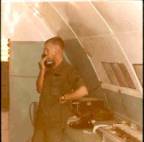 When
the radio sounds off with, " Queen Tonic, Queen Tonic, this
is Dustoff 31" And the A&D Clerk (in this case, Sgt. Brown,
A&D Ch.) Answers, "Dustoff 31, Oueen Tonic…
When
the radio sounds off with, " Queen Tonic, Queen Tonic, this
is Dustoff 31" And the A&D Clerk (in this case, Sgt. Brown,
A&D Ch.) Answers, "Dustoff 31, Oueen Tonic…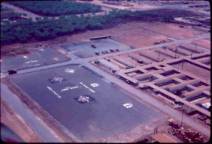 When
the Dustoff Pilot sees this, he knows he is delivering his casualties
to the one location in Vietnam where they are going to receive the
lifesaving treatment they are entitled to, where each patient is
an individual, not a statistic…
When
the Dustoff Pilot sees this, he knows he is delivering his casualties
to the one location in Vietnam where they are going to receive the
lifesaving treatment they are entitled to, where each patient is
an individual, not a statistic…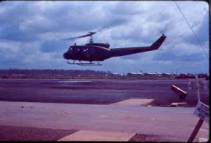 As
the Dustoff is landing, the A&D litter bearers are getting ready
to do the Third Hardest part of their job; remove the casualties
on board and bring them into the Emergency Room to begin the first
stage of their lifesaving treatment. The patient's first contact
with the 24th Evac. is with the personnel of the Admissions & Dispositions
Section (A&D) of Registrar.
As
the Dustoff is landing, the A&D litter bearers are getting ready
to do the Third Hardest part of their job; remove the casualties
on board and bring them into the Emergency Room to begin the first
stage of their lifesaving treatment. The patient's first contact
with the 24th Evac. is with the personnel of the Admissions & Dispositions
Section (A&D) of Registrar.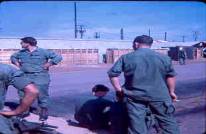 Litter
Bearers are on hand waiting for the Dustoff to land on the "Hot
Pad"
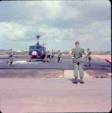
Litter
Bearers are on hand waiting for the Dustoff to land on the "Hot
Pad"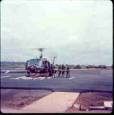

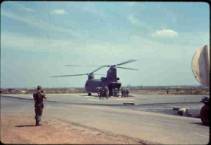 Not
all casualties arrive by Dustoff, as attested to by this view of
a CH-47 Chinook Helicopter from the 101st Air Assault
Div. which landed on our administrative pads, without calling on
the radio and telling us they had casualties….It wasn't until
we observed that something was obviously wrong that our litter bearers
went charging out to remove the casualties…
Not
all casualties arrive by Dustoff, as attested to by this view of
a CH-47 Chinook Helicopter from the 101st Air Assault
Div. which landed on our administrative pads, without calling on
the radio and telling us they had casualties….It wasn't until
we observed that something was obviously wrong that our litter bearers
went charging out to remove the casualties… 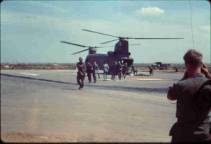 Never
fear, the A&D guys were near….
Never
fear, the A&D guys were near….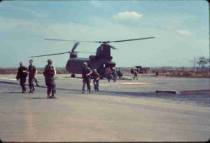 The
A&D guys got them all ….. ambulatory and stretchers for
those who should have been on stretchers in the first place…they
had lifted them right out of a rice paddy and it was very obvious….they
were the first batch we received from the 101st. Div., not
the last however….seems as though after this first group
went through the 24th, our fame was spreading rapidly….
The
A&D guys got them all ….. ambulatory and stretchers for
those who should have been on stretchers in the first place…they
had lifted them right out of a rice paddy and it was very obvious….they
were the first batch we received from the 101st. Div., not
the last however….seems as though after this first group
went through the 24th, our fame was spreading rapidly….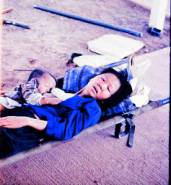 Not
all the sick, hurt and wounded who were brought to the 24th
were G.I.s, we also received Local Nationals who were injured by
either American operations or injured in traffic accidents that occurred
near Long Binh Post were brought to either us or the 93rd Evac.
Often we thought we got more than our fair share…
Not
all the sick, hurt and wounded who were brought to the 24th
were G.I.s, we also received Local Nationals who were injured by
either American operations or injured in traffic accidents that occurred
near Long Binh Post were brought to either us or the 93rd Evac.
Often we thought we got more than our fair share…
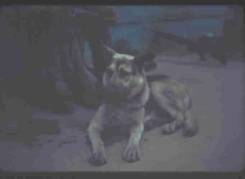 Well,
you know how it is, at the 24th, a patient is a patient
as illustrated by Charlie….
Well,
you know how it is, at the 24th, a patient is a patient
as illustrated by Charlie….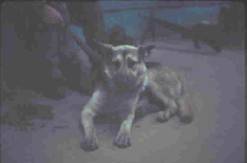 It's
been a looong day!!!
It's
been a looong day!!!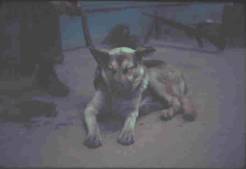 Gee,
I'm Tired!!!
Gee,
I'm Tired!!!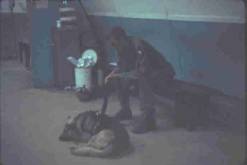 Good
Night, Charley…(shuuu!!), Tired Soldier
Good
Night, Charley…(shuuu!!), Tired Soldier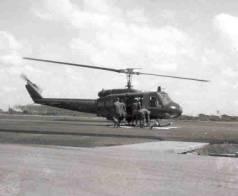 Just
doing one part of the job…it is easier in good weather.
Just
doing one part of the job…it is easier in good weather. It
gets a little tougher during the monsoons, especially at night …
It
gets a little tougher during the monsoons, especially at night … I
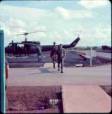
realize you cannot tell much from this picture but that is a Huey
setting down on our 'Hot Pad' during a driving rain at night. We
had to talk him in on the radio (I know because I was the one standing
outside, in the rain guiding the chopper to our pad).
I
realize you cannot tell much from this picture but that is a Huey
setting down on our 'Hot Pad' during a driving rain at night. We
had to talk him in on the radio (I know because I was the one standing
outside, in the rain guiding the chopper to our pad).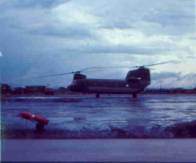 Thankfully,
we did not get this "Big Fella" in at night, it was enough
of a problem to get the casualties off in daylight as it was during
one of those 'delightful' monsoon showers and those big rotors really
whipped you with the rain…..
Thankfully,
we did not get this "Big Fella" in at night, it was enough
of a problem to get the casualties off in daylight as it was during
one of those 'delightful' monsoon showers and those big rotors really
whipped you with the rain…..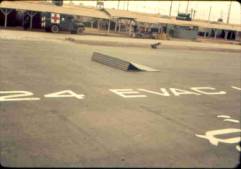 This
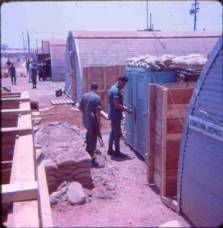
is what happened when we first built our "hot pad" and
one of the 'big boys' landed next to it….
This
is what happened when we first built our "hot pad" and
one of the 'big boys' landed next to it….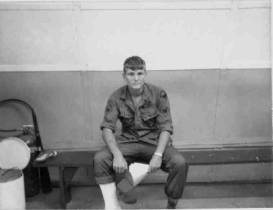 Yes,
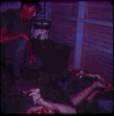
we really did get ambulatory patients as illustrated by this Sp.4,
from the 9th ID, waiting in A&D's "luxurious" waiting
area for transport to his unit.
Yes,
we really did get ambulatory patients as illustrated by this Sp.4,
from the 9th ID, waiting in A&D's "luxurious" waiting
area for transport to his unit.
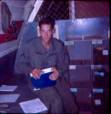
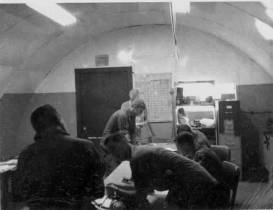 Once
the casualties are safely off the choppers, out of the ER, and into
pre-op, the work of the A&D Clerks is not over, now the admission
paperwork has to be done and the beginning of the patient chart has
to be married up with the paperwork that was begun in the ER.
Once
the casualties are safely off the choppers, out of the ER, and into
pre-op, the work of the A&D Clerks is not over, now the admission
paperwork has to be done and the beginning of the patient chart has
to be married up with the paperwork that was begun in the ER.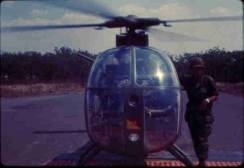 These
are about the only types of helicopters that didn't bring casualties
to the 24th…
These
are about the only types of helicopters that didn't bring casualties
to the 24th…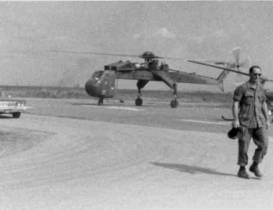 Sikorski
Flying Crane
Sikorski
Flying Crane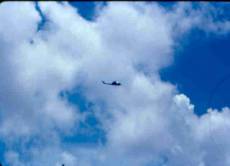 Cobra
Attack Helicopter
Cobra
Attack Helicopter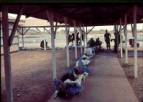 The
guys in A&D were the first to make contact with the incoming
casualty and needless to say, they were the last ones to make contact
with them as they left the 24th Evac.
The
guys in A&D were the first to make contact with the incoming
casualty and needless to say, they were the last ones to make contact
with them as they left the 24th Evac.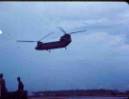 And
a last look at Long Binh Post from the rear of the Chinook…
And
a last look at Long Binh Post from the rear of the Chinook…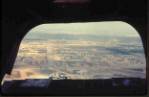 Good
bye Long Binh, we won't miss you!!!
Good
bye Long Binh, we won't miss you!!! Thus
the patient experience with the 24th Evac. Hospital has
begun and ended with the silent dedication of the troops assigned
to the A&D Section of Registrar.
Thus
the patient experience with the 24th Evac. Hospital has
begun and ended with the silent dedication of the troops assigned
to the A&D Section of Registrar.